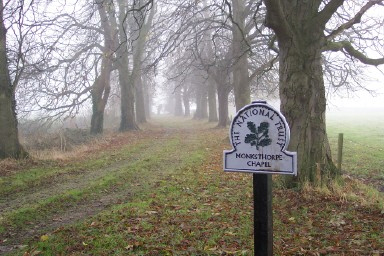
This historic Chapel is now owned by the National Trust
See the National Trust Page for details!
The Services are organised by
The Friends of Monksthorpe

Contents
lick on the label to see information about the proposed Triton Knoll Sub Station https://www.monksthorpe.com/tritonknoll.htm
Click on the label to see details of the 2011 Flower Festival
Click on the 'label' to view the pictures of the 2009 Flower Festival https://www.monksthorpe.com/flower_festival.htm
Click on the 'label' to view the latest news of the involvement of the National Trust at Monksthorpe
and details of the Cottage Restoration Project at Monksthorpe 'National Trust at Monksthorpe'
Click on the 'label' to read an extract of a History of Monksthorpe and the early Baptists of Lincolnshire 'History'
Click on the label to see some visitors to Monksthorpe Visitors
Click on the label to see a list of ministers Ministers
Click on the 'label' to see a page of Web Sites that have associations with the Monksthorpe Chapel Link Page
Click on the label to see a Plan of the Graves Plan of Graves at Monksthorpe
Click on the label to see the graves' Inscriptions Graves Inscriptions
Click on the label to see Graves numbered and named Graves Numbered and Named
This is a page about the historic Monksthorpe Baptist Church in Lincolnshire which is situated between Spilsby and Burgh-le-Marsh
in a remote and secluded spot which was specially chosen for its secrecy during times of persecution in the late 1600's.
Travel Directions
From Candlesby on the Lincoln-Skegness Road, turn south and follow the narrow
road to a T junction.
Turn left and immediately straight on along 'No-through Road'.
Pass two farms and when the track narrows, turn right into the tree-lined church drive!
The car park is by the entrance gate!
For Sat Nav users, the Post Code is PE23 5PP
That will get you close, within sight of the Sign pointing to the chapel
at the end of the 'No-Through Road'
The Early Baptists
After leaving England as one of the persecuted Separatists, Thomas Helwys
returned to England from the continent in 1612 and founded the first Baptist
Church on English soil at Spittalfields which was then just outside London. By
the year 1651, the Baptist cause had reached Lincolnshire and small groups were
meeting for worship. As it was not safe for them to do so, they met in secrecy.
A group formed and met at the 'Preaching Tree' in the croft of Monksthorpe. They
worshipped in the open air while watch was kept from the nearby trees to give
warning of the approach of the King's soldiers. People walked to worship at
Monksthorpe from distances of many miles. There was not a resident congregation
at Monksthorpe which had been chosen for its seclusion. This was at a time when
it was not safe to be other than a member of the established church. Therefore
the congregation at Monksthorpe was always intended to be a non-residential one!
But - In 1781 there are records to show that Monksthorpe had a membership of
eighty-one. Since that time numbers have fluctuated, its very seclusion being a
hindrance to numerical prosperity.
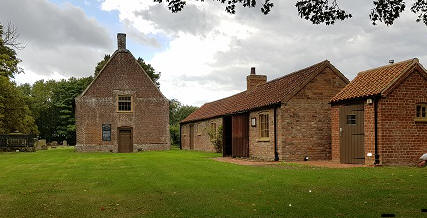
The Chapel
When the building was erected in 1701 at a time when acceptance of Dissent was
in the air due to the Toleration Act, there was a suspicion that persecution
might return. Therefore the chapel building was erected in the form of a
farmyard barn with a thatched roof; and an escape hatch above the pulpit so that
the preacher might make a hurried exit on a horse tethered outside should that
be necessary! The thatched roof was replaced with tiles in 1847, when the
vestries were also added

The Baptistry
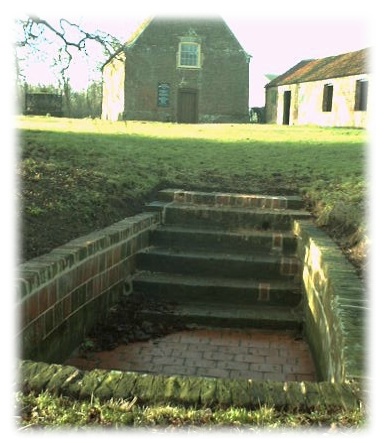
An open air baptistry is in the grounds of Monksthorpe and was also used by the congregation at Burgh-le-Marsh until they had their own baptistry in 1873, which was used for the first time on 2nd March of that year. The congregation at Monksthorpe was formed when it was unsafe to worship within a town and so the congregation of Burgh-le-Marsh met at the Preaching Croft and so were part of the founding of Monksthorpe Baptist Church. The two churches have been linked since formation and this is further detailed in the 'History' Pages!
The baptistry was filled by flooding in water from the dyke behind it! That can't happen now as the water-table is lower than it was due to drainage work.
The baptistry was last used in 1972.
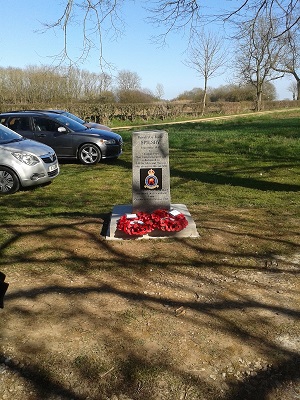
Memorial to commemorate the nearby Bomb Dump Explosion
At 8pm on 10th April 1944 an accident caused an explosion when a bomb was being prepared for loading onto a Lancaster Bomber.
This happened close to the Bomb Dump on the RAF Airfield known as RAF Spilsby.
This is adjacent to the Chapel grounds. Therefore, this memorial has been sited as close to the Bomb Dump area as possible by placing it just inside the entrance to the driveway to the chapel.
It recalls the loss of ten lives.
Worship
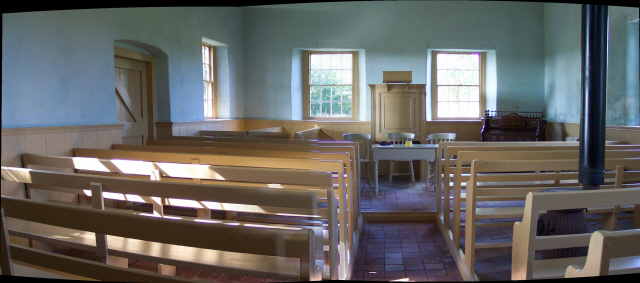
Regular worship ceased at the chapel in the late 1970's and the building fell
into disrepair. The roots of a large tree to the rear of the building caused
some disturbance to the foundations which has led to one wall having a
substantial list. The offending tree has been removed and a 'hoop-safe'
foundation has been inserted making the building safe again.
The 'Friends of Monksthorpe' worked to bring mains water to the chapel, install
a toilet, new windows and other repair work to allow the chapel to be used for
worship again. Seven or eight services are held each year, dates found by
clicking on the
Dates of Future
Services
'button' above.
When the National Trust took ownership they completely refurbished the chapel and it is now close to the standard when it was extensively repaired and balcony and vestries added in 1847.
Although it is in an isolated position we have good congregations attending.
More than a hundred at the harvest service is quite usual!
This is a chapel of great historical significance. Monksthorpe has its roots in
the early days of the Baptists, it developed from the South Marsh Church which
met in secrecy during times of persecution, and was one of the churches known to
Thomas Grantham, an important early Baptist who was born in the neighbouring
village of Halton Holegate.
Part of the agreement with the National Trust is that we Baptists will continue
to hold our services there each year and they will be organised by the 'Friends
of Monksthorpe' who will act as the congregation and membership of the church.
Friends of Monksthorpe
This organisation was formed in order to help to save this very historic chapel, to raise some funds in order to help with the preservation and restoration and the on-going running of the chapel. As stated earlier, the 'Friends' act as the members of the church and as such are responsible for some running costs, organising services, cleaning and some maintenance of the grounds etc.
We have a dedicated small team who help with grass mowing and chapel cleaning etc. We are also needing to provide some of the reserve funds which will be used by the Trust for future maintenance work. Therefore we are seeking new members of the Friends of Monksthorpe - for a minimum of £5 per year ( you are allowed to give more!) you receive newsletters from time to time and have the joy of knowing that you are helping to preserve some important Baptist History, a part of history that is still active!
This site is maintained by the Rev. Bryan Keyworth, who lives in Newthorpe, Nottingham
You may make a direct link to the National Trust
Click below!